
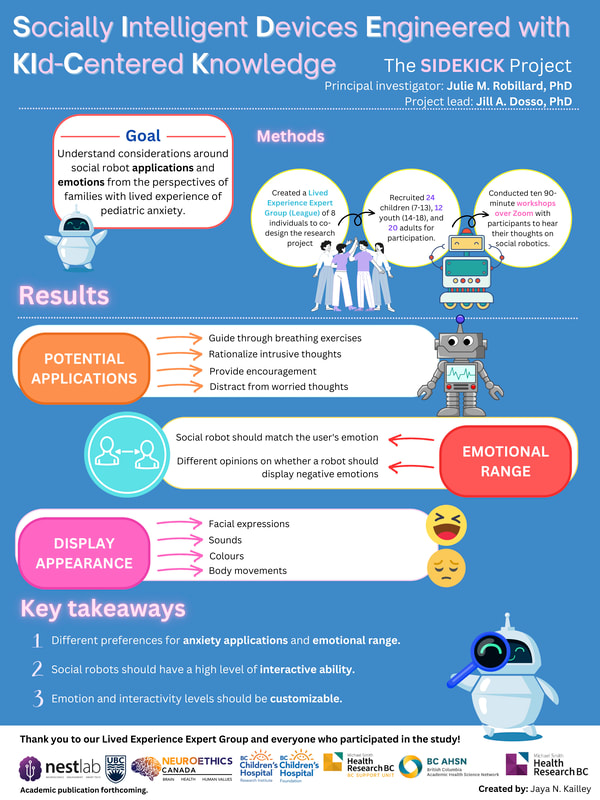
Social robots – devices created to support social interaction – have shown promise in supporting children and families living with anxiety. In this work, we aimed to co-create social robots with families with lived experience of anxiety.
|
Why is this research important?
When technologies are developed without consulting end-users, they tend to reflect the priorities of developers and experts. Including children and families with an experience of anxiety in social robot development will promote the creation of interventions that are helpful and meaningful for this population. What did we do? The team conducted co-creation workshops with children, youth, and parents with lived experience of pediatric anxiety. Workshops included discussion around social robot applications and emotional considerations. A lived experience expert group provided feedback throughout the research. What did we find? Participants expressed desire for a robot that could guide them through breathing exercises, help them deal with intrusive thoughts, distract them from worrying thoughts, and provide encouragement. Participants also discussed various impacts of a robot’s emotional display. |
|
Publications & Media

Blogpost | Centering persons with lived experience in brain health technology research
Team Members

Dr. Julie Robillard
Principal Investigator |

Dr. Jill Dosso
Postdoctoral Fellow |

Jaya Kailley
Research Assistant |

Susanna Martin
Research Assistant |
Co-Investigators:
The League (Lived Experience Expert Group)
Dr. François Michaud (Co-investigator – Université de Sherbrooke; TTOP robot)
Dr. Tony Prescott (Partner – Consequential Robotics; MiRo robot)
Funders
We are proud to have received funding for this project from the following organization:

|

|

|

|

|
